London’s Lost Jewels Beneath a Cellar Floor
Few archaeological discoveries provide such an intimate view of the early modern jewellery trade as the Cheapside Hoard.
Hidden beneath the floor of a London cellar, the collection contained around five hundred pieces of jewellery, loose gemstones, watches, chains, brooches, rings, buttons and small luxury objects. Some were finished jewels ready to be sold. Others had been dismantled, damaged or set aside for repair and reuse.
The collection included Colombian emeralds, Indian diamonds, Persian turquoise, sapphires and rubies from Asia, ancient carved gems and even imitation stones designed to deceive an unsuspecting buyer.
For nearly three centuries, no one knew it was there.
Then, in the summer of 1912, a workman’s pickaxe broke through the cellar floor.
A Treasure Beneath One of London’s Busiest Streets
The discovery was made in Cheapside, close to St Paul’s Cathedral in the heart of the City of London.
Today, Cheapside is surrounded by offices and modern shops, but during the late sixteenth and early seventeenth centuries it was one of London’s most important commercial streets. Its name derives from the old word chepe, meaning a market or place of trade.
Cheapside was also the centre of London’s goldsmithing industry. One section was known as Goldsmiths’ Row, where shops displayed gold, silver, gemstones and luxury objects to wealthy customers. A Venetian visitor writing in 1503 was astonished by the number and size of the goldsmiths’ shops and believed that their combined contents rivalled those of several major Italian cities.
The buildings at the corner of Cheapside and Friday Street stood on property associated with the Goldsmiths’ Company. Beneath them were older, brick-lined cellars that had survived successive phases of rebuilding.
It was below one of these cellar floors that the jewellery had been concealed.
The Day the Pickaxe Struck
In June 1912 traditionally dated to 18 June workmen were demolishing a row of old buildings at approximately 30–32 Cheapside.
While breaking through the cellar floor, one of the men noticed something shining in the soil. Further digging revealed the decayed remains of a wooden box or casket. As the container collapsed, a tangled mass of gold, gemstones and jewellery spilled into the dirt.
There was no archaeologist present. No photograph was taken of the box in the ground, and no formal inventory was made before the objects were removed.
Later accounts suggest that the workmen began filling their pockets, caps and handkerchiefs with the jewels. Some pieces may have disappeared immediately and never reached a museum. The true original size of the collection may therefore have been even greater than the approximately five hundred surviving objects.
The men did, however, know someone who regularly bought interesting objects found during London demolition work.
His name was George Fabian Lawrence.
Stony Jack and the Demolition Men
George Lawrence was a pawnbroker, antiquities dealer and collector better known by his nickname, “Stony Jack”.
At a time when London was being extensively rebuilt, labourers regularly uncovered pottery, coins, tools, jewellery and other archaeological objects. Most construction companies regarded these finds as rubbish. Without intervention, they were often thrown into skips, loaded onto barges and dumped outside the city.
Lawrence created an informal network among London’s demolition workers. He taught them that apparently insignificant objects might have historical value and promised to pay them for anything interesting they recovered.
Payment might be made in cash—or in beer.
By 1912, Lawrence had also been appointed an inspector of excavations for the recently established London Museum. When the Cheapside workmen brought him the jewels, he immediately recognised that their discovery was extraordinary.
The objects reportedly arrived gradually, carried in parcels and handkerchiefs as different members of the demolition crew brought in what they had taken. Lawrence bought the material and arranged for it to enter museum collections, preserving a treasure that might otherwise have been divided, melted down or sold anonymously.
The manner of the discovery created one of the enduring problems surrounding the hoard: no one can be certain that every object found beneath the cellar floor was recovered.
Some jewels may still have been carried away by the workmen or sold privately. From time to time, objects with a possible connection to the hoard have appeared on the market, although proving such a link is extremely difficult.
Not a Queen’s Jewellery Box
At first glance, the Cheapside Hoard might appear to be the personal jewellery collection of an exceptionally wealthy aristocrat.
The contents, however, tell a different story.
The hoard combines fashionable, completed jewels with loose gemstones, broken settings, unfinished objects and stones that had been removed from older pieces. Some items appear ready for sale, while others were probably waiting to be repaired, redesigned or melted down.
There are also jewels of widely different quality and value. Magnificent emeralds and diamonds appear alongside inexpensive glass, fossilised fish teeth and deliberately imitated gemstones.
This is not what would normally be found in a single aristocratic jewel box. It is much closer to the contents of a professional workshop.
Most specialists therefore believe that the hoard represented the stock-in-trade of a working goldsmith-jeweller, gemstone merchant or perhaps a group of associated dealers. The owner may have sold new jewellery, accepted pieces for repair, traded in loose stones and dismantled older jewels for their reusable materials.
A wealthy collector or even a receiver of stolen property has occasionally been proposed. Nevertheless, the combination of finished jewellery, loose stones and workshop material makes the professional-jeweller explanation the most convincing.
A Global Jewellery Trade Beneath London
The Cheapside Hoard is remarkable not only for the number of its objects, but also for the geographical range of its materials.
Its gemstones had travelled to London from across the known world.
The emeralds came primarily from Colombia. Diamonds arrived from India and possibly Borneo. Rubies, sapphires and spinels were sourced from Sri Lanka and Burma. Turquoise came from Persia, lapis lazuli from Afghanistan and pearls from regions including the Persian Gulf.
Other stones may have come from Egypt, Central Europe and the Mediterranean.
London goldsmiths did not deal only in newly mined material. The hoard also contains ancient Greek, Roman, Byzantine and Egyptian carved gems that had already been treasured and traded for many centuries before reaching Cheapside.
The collection therefore represents an early form of globalisation. Gemstones moved through complicated networks of miners, merchants, colonial agents, sailors, cutters and goldsmiths before arriving in London.
The beauty of these objects should not obscure the violence behind some of those networks. European expansion during this period involved conquest, colonisation, forced labour and the trafficking of enslaved people. The Colombian emeralds and Asian diamonds in the hoard were part of an increasingly global economy whose wealth was distributed very unevenly.
The Emerald Watch
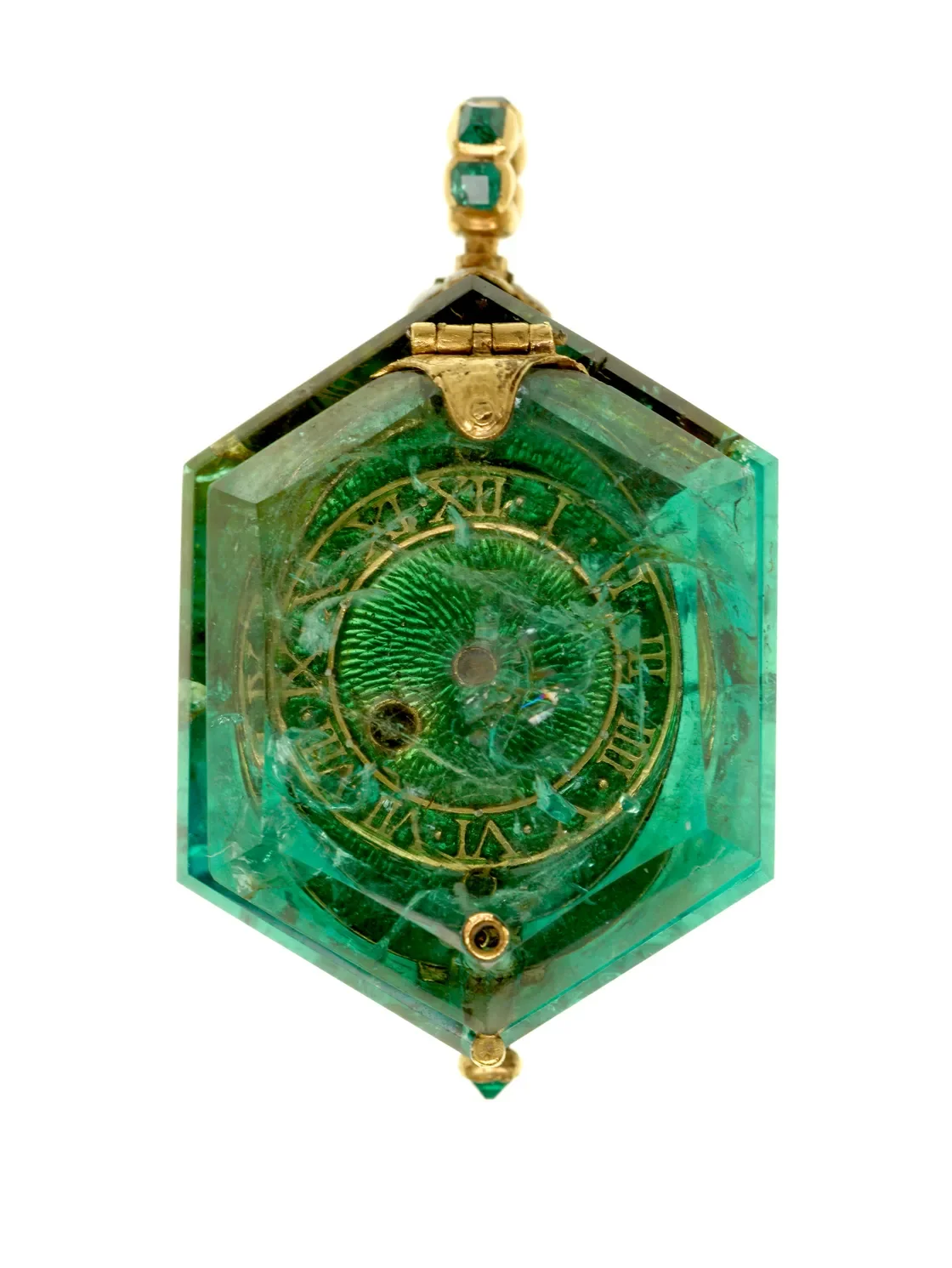
The most technically astonishing object in the collection is a tiny watch housed within a single enormous emerald.
Made around 1600–1610, the watch case was cut from a large hexagonal emerald crystal originating in Colombia. The stone was hollowed out to accommodate the miniature mechanical movement, while the dial was decorated with translucent green enamel.
The entire object measures only a little over three centimetres.
Cutting such a cavity into an emerald required extraordinary skill. Emeralds often contain internal fissures and inclusions, and the slightest error could have shattered the crystal. The person responsible had to remove material from the centre while preserving enough strength in the surrounding walls to protect both the stone and the watch mechanism.
The emerald may have been cut or assembled in a major European jewellery centre such as Seville, Lisbon, Geneva or London. Its precise workshop remains unknown.
The object was not intended merely to tell the time. Early watches were expensive curiosities, admired as demonstrations of mechanical and artistic ingenuity. A watch encased in one of the world’s most desirable gemstones was a wearable expression of education, wealth and access to international trade.
Ironically, the missing watch hand means that this spectacular timepiece can no longer perform its most basic function.
The Salamander That Could Survive Fire
Another celebrated piece is the salamander brooch.
Its curved body is formed from ten large cabochon emeralds. Small diamonds originally lined the sides, while its legs and other details were picked out in white enamel. The creature raises its head, opens its mouth and curls its tail as though moving across the wearer’s clothing.
In Renaissance and early Stuart symbolism, the salamander was believed to possess the ability to live in or pass through fire. It therefore became associated with endurance, resurrection and protection.
The emerald body reinforced the creature’s exotic appearance, while the combination of Colombian gemstones and Indian diamonds again demonstrates the international character of London’s jewellery trade.
The jewel acquired an additional layer of irony after its burial. It survived underground while the buildings above were eventually destroyed by the Great Fire of London.
A Frog Inside a Moonstone
Not every object in the hoard is grand or formal.
One small gold ring is set with a pale, rounded moonstone. Beneath its softly glowing surface is the carved image of a frog.
The animal appears almost to float inside the stone.
The frog is not painted onto the front. It was carved into the moonstone to make use of the gemstone’s translucency, creating a miniature image that changes subtly as light passes through it.
The moonstone probably originated in Sri Lanka, while the carving may have been completed in Italy or another specialist European centre before being mounted in London.
The ring is a reminder that Renaissance and Stuart jewellery could be witty and personal. Jewels did not always need to communicate royal authority or religious devotion; they could also display curiosity, humour and a love of unusual natural subjects.
Perfume, Grapes and Bows
The hoard also contains luxurious objects that reveal the sensory world of elite seventeenth-century life.
A richly decorated scent bottle was designed to hold perfume made from flower distillations and spices. Its gold body is embellished with enamel, diamonds, opals, rubies, spinels and carved chalcedony panels. The screw top allowed the perfume to be carried on the body without spilling.
Other ornaments take the form of bunches of grapes. Small green or purple stones and glass beads were arranged into fruit-like clusters suspended from enamelled branches.
Bow-shaped jewels were set with rubies and diamonds. Chains were decorated with intricate enamelled links, while rings displayed table-cut diamonds, coloured stones and miniature carvings.
These pieces show that jewellery of the period was often designed to move. Drops, clusters and suspended elements would have caught the light as the wearer walked, danced or turned their head.
Ancient Faces Among Stuart Jewels
Some of the most mysterious objects in the hoard were already ancient when they were buried.
One carved gemstone, approximately two thousand years old, depicts the head of a Ptolemaic queen. She wears a headdress associated with the Egyptian goddess Isis and has sometimes been identified as Cleopatra VI, although the precise identity remains uncertain.
Another jewel incorporates an early Byzantine sapphire carving showing the biblical episode known as the Incredulity of Saint Thomas.
There is also a carved portrait of Elizabeth I and numerous Classical-style intaglios and cameos.
Such stones were highly desirable during the Renaissance. Collectors admired them as surviving fragments of Greece, Rome, Egypt and Byzantium. Goldsmiths frequently remounted ancient carvings in contemporary settings, giving them a new life as pendants, rings or cabinet objects.
The presence of these gems in a commercial hoard suggests that London jewellers participated in an international market for antiquities as well as newly mined gemstones.
A carving might therefore be ancient, its gold setting Elizabethan and its final owner Jacobean.
The Pearls That Disappeared
The Cheapside Hoard originally contained far more pearls than survive today.
Pearls are organic gems. Unlike diamonds, rubies or sapphires, they can deteriorate when exposed to moisture and soil for long periods. During almost three centuries underground, most of the pearls decomposed.
Empty wires and settings allow researchers to estimate what has been lost. It has been suggested that the collection may originally have contained approximately four thousand pearls, perhaps even more if loose examples were included.
One surviving chain originally held more than five hundred tiny pearls. Only seven remain.
The absence of the others creates a strangely incomplete appearance: delicate gold wirework survives, but the lustrous white surface that once covered it has vanished.
The surviving jewellery therefore gives only a partial impression of its original splendour. In the early seventeenth century, many of the pieces would have looked much brighter, softer and more luxurious than they do today.
The Counterfeit Ruby
Among the real emeralds, diamonds and sapphires is evidence that gemstone fraud is not a modern invention.
One pendant contains a piece of inexpensive rock crystal that was deliberately altered to resemble a valuable red spinel, historically known as a balas ruby.
The maker heated and rapidly cooled the crystal, creating a network of small internal cracks. Red dye—possibly made using cochineal insects—was then introduced into the fissures. The result would originally have appeared convincingly red.
After centuries underground, much of the colour faded, revealing the deception.
The object raises an intriguing question. Was the jeweller who owned the hoard knowingly selling fraudulent stones? Had the fake been accepted unknowingly? Or was it kept as an example of a known imitation?
No answer survives.
It does, however, demonstrate that customers in early seventeenth-century London faced many of the same risks encountered in the jewellery trade today: treated stones, artificial materials and sellers who did not always disclose what they knew.
Jewels from a Toad’s Head
Even stranger are the so-called toadstones.
In early modern Europe, people believed that a magical stone could sometimes be found inside the head of a toad. The stone was thought to detect or protect against poison, occasionally by becoming warm or changing colour when danger was nearby.
Fourteen such “stones” were discovered in the Cheapside Hoard.
They did not come from toads.
Most are fossilised teeth from an extinct species of fish that lived approximately 150 million years ago. Their rounded shape was interpreted as evidence of their supernatural origin, and they were mounted in rings or amulets as protective objects.
To a seventeenth-century customer, a toadstone ring was not simply decorative. It might be regarded as a practical defence against poisoning an understandable concern in a world where sudden illness could easily be interpreted as deliberate murder.
Dating the Burial
For many years, specialists believed the hoard had been hidden in the early seventeenth century.
One small, damaged object eventually provided a more precise clue.
A chipped carnelian intaglio bears the heraldic badge of William Howard, who became Viscount Stafford upon his marriage to Mary Stafford in 1640. Because the badge did not exist before that year, the hoard cannot have been buried earlier.
Evidence from the site provides the other end of the date range. The buildings above the cellar were destroyed during the Great Fire of London in 1666. The hoard must therefore have been placed underground sometime between 1640 and 1666.
Many researchers favour a date in the early 1640s, close to the beginning of the English Civil War.
That would explain why a jeweller might suddenly have felt the need to hide an entire business beneath the floor.
Why Was It Never Recovered?
The hoard appears to have been concealed by someone who intended to return.
The box was placed beneath a cellar floor rather than discarded. Its owner had taken the trouble to hide objects representing considerable wealth and probably expected the location to remain secret.
The most obvious explanation is the English Civil War, which began in 1642. London’s goldsmiths were affected by political and military upheaval. Some left the city, some joined the fighting and others may have feared confiscation, theft or economic collapse.
The owner might have buried the stock before leaving London, only to die in battle, remain in exile or lose ownership of the property.
Yet the Civil War is not the only possibility.
The treasure may have been hidden as part of an ordinary security practice. Commercial banking was still limited, and a carefully concealed cavity beneath a workshop floor could function as a private safe. Perhaps the owner regularly stored valuable stock there.
The burial period also includes the Great Plague of 1665, during which many Londoners fled the city. The owner may have died from disease or left London in circumstances that made returning impossible.
Finally, the Great Fire of 1666 destroyed the buildings above the cellar. Even if the owner survived, the exact hiding place may have disappeared beneath ruins and subsequent rebuilding.
No document records the burial. No name can be securely connected to the box.
The owner’s secret died with them.
The Great Fire Passes Overhead
The Great Fire began on 2 September 1666 in a bakery on Pudding Lane.
Over four days, flames destroyed thousands of houses, churches, guild buildings and shops. Cheapside and the old St Paul’s Cathedral were devastated.
The structures standing above the hoard were destroyed, but the deeper brick-lined cellar survived. When London was rebuilt, new buildings were constructed over the older foundations.
The forgotten jewellery was sealed beneath the city.
It remained there through the Restoration, the Georgian period, the reign of Queen Victoria and the transformation of London into a modern metropolis. Generations of people walked, traded and built above the treasure without knowing it existed.
The salamander beneath the floor an animal believed to survive fire had done precisely that.
From Workmen’s Pockets to Museum Cases
The London Museum acquired the majority of the hoard in 1912 through Stony Jack’s intervention.
Almost all of it remains in the London Museum’s collection. Five pieces are held by the Victoria and Albert Museum, while twenty-five are in the British Museum.
The collection has since been studied by historians, gemmologists, jewellery specialists and archaeologists.
Its importance lies partly in its extraordinary survival. Fine jewellery is usually altered over time. Precious stones are removed, settings are melted down and styles are adapted to suit later fashions. As a result, relatively little English jewellery from the Elizabethan and early Stuart periods has survived intact.
The Cheapside Hoard escaped this cycle because it disappeared.
Its jewels were neither sold nor remounted. Many remained exactly as they had been when the box was placed beneath the floor.
London’s Jewellery Trade Preserved in Time
The Cheapside Hoard is not a single royal jewel with a famous name.
It has no confirmed monarch, aristocrat or celebrated collector attached to it. Its owner remains unknown and its reason for burial uncertain.
Yet that anonymity is part of what makes the collection so important.
The hoard shows the jewellery trade from the inside. It contains not only masterpieces, but repairs, broken objects, loose gemstones, ancient carvings, protective amulets and convincing fakes.
It reveals what London jewellers bought, sold, reused and valued. It shows how far gemstones travelled and how old objects were transformed for new generations. It also exposes the anxieties of the period: fear of poison, fear of fraud and fear of political instability.
The emerald watch represents technical genius. The salamander reflects Renaissance symbolism. The frog ring reveals humour. The imitation ruby exposes deception. The missing pearls remind us that even buried treasure does not remain unchanged.
The Jewellery Box No One Came Back For
Someone once stood in a Cheapside cellar with an extraordinary decision to make.
They gathered finished jewellery, loose stones, ancient carvings and valuable stock into a wooden box. They lifted part of the floor, placed the container beneath it and carefully concealed the opening.
Perhaps fighting had begun. Perhaps soldiers were approaching. Perhaps the owner was preparing to leave London for only a few weeks.
They clearly believed they would return.
They never did.
The buildings burned, the city was rebuilt and the wooden box slowly collapsed. Pearls dissolved, metal twisted and soil entered the settings. Above it, London continued for almost three hundred years.
Then a workman’s pickaxe struck the floor, and one of the most complete surviving worlds of Elizabethan and Stuart jewellery suddenly returned to the light.
