From the Diamond Mines of India to the Smithsonian
Few gemstones have lived as many different lives as the Hope Diamond.
It began as an unusually large blue diamond in seventeenth-century India, became a symbol of royal power at the court of Louis XIV, disappeared during one of the most audacious robberies of the French Revolution and resurfaced in London in a dramatically altered form. It later passed through the hands of bankers, aristocrats, jewellery dealers and American millionaires before being sent to the Smithsonian Institution in an ordinary brown parcel.
Along the way, fact became inseparable from legend. Stories of theft, betrayal, financial ruin and a supernatural curse transformed the Hope Diamond from an exceptional gemstone into one of the most famous jewels in the world.
Tavernier and the Blue Diamond of India
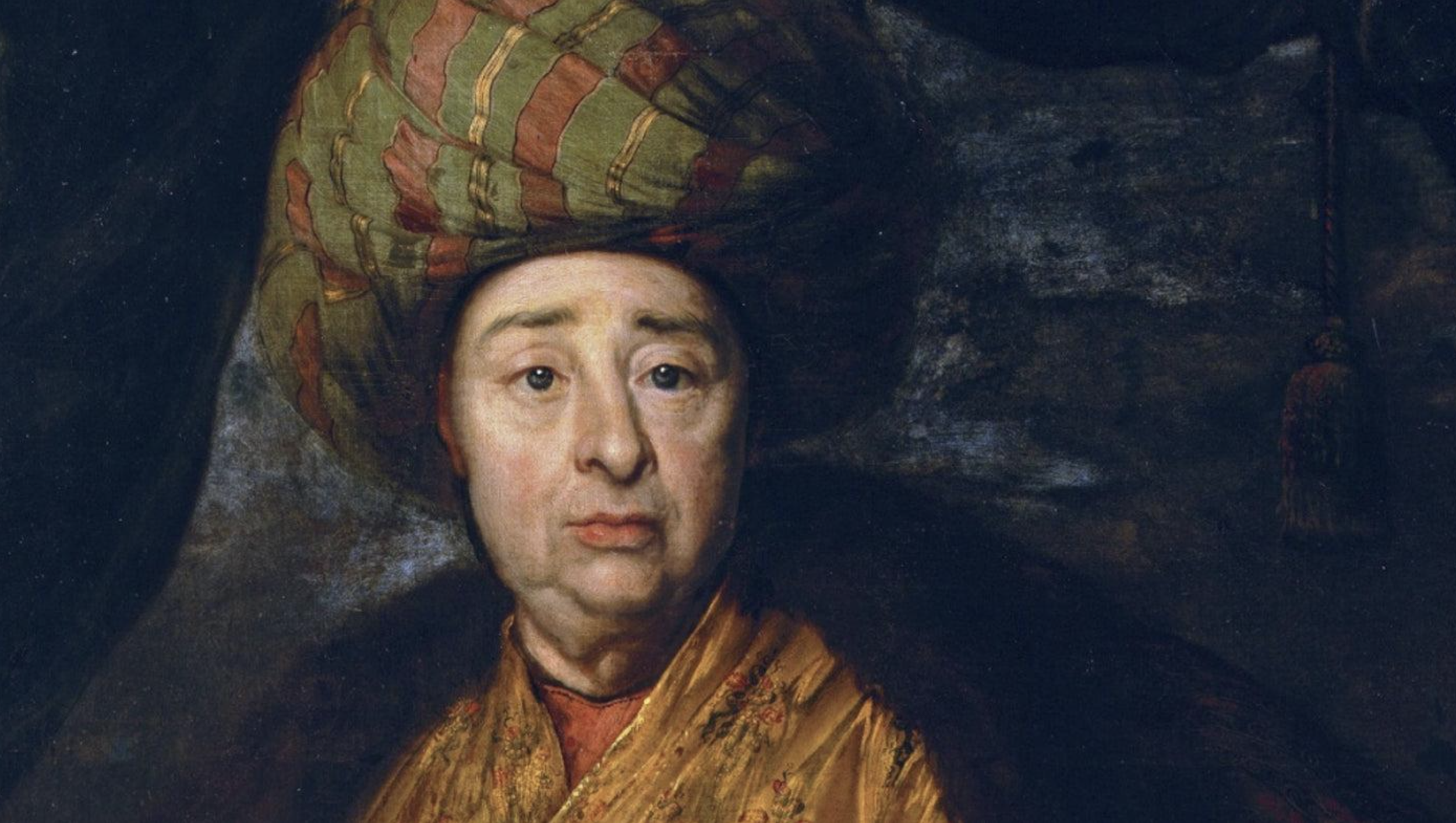
The documented history of the Hope Diamond begins with Jean-Baptiste Tavernier, a French merchant, traveller and specialist in precious gemstones.
During the seventeenth century, India was the world’s principal commercial source of diamonds. Tavernier made six major journeys through Persia and India, visiting courts, trading centres and diamond-producing regions. His detailed accounts later provided Europeans with some of their earliest descriptions of Indian diamond mining and the international gemstone trade.
During his sixth journey, between 1664 and 1668, Tavernier acquired an extraordinary blue diamond. In the old French system it weighed 112 3/16 carats, equivalent to approximately 115 modern metric carats. Its shape was irregular and somewhat triangular, with broad polished surfaces rather than the carefully symmetrical faceting expected in later European jewellery.
Tavernier described its colour as a beautiful violet, although in seventeenth-century terminology this could refer to an intense shade of blue. The stone most likely came from the Kollur Mine in the Golconda region, an important source of large and coloured diamonds. However, its exact origin remains uncertain because Tavernier never recorded where, when or from whom he acquired it.
This silence was probably deliberate. A successful gemstone merchant had little reason to reveal his suppliers, purchase prices or most profitable trading connections.

The Theft That Probably Never Happened
A much more dramatic version of the story appeared later.
According to one popular legend, the diamond had formed part of the eye or forehead of a Hindu idol. Tavernier supposedly stole it from a temple, provoking the anger of a deity and placing a curse upon everyone who subsequently owned the stone.
In some versions, Tavernier was punished by being torn apart by wild dogs or killed by other animals while travelling through Russia.
There is no reliable historical evidence for any of this.
Tavernier was an experienced and highly successful international merchant who conducted business with rulers, nobles and established gemstone dealers. The available evidence suggests that he obtained the blue diamond through trade, although the precise transaction is unknown. He was not killed by wild animals: he lived into his eighties and died in 1689.
The temple story was developed much later as part of the mythology surrounding the so-called curse of the Hope Diamond. The uncertainty surrounding Tavernier’s original acquisition simply provided a convenient blank space into which later storytellers could insert a more sensational beginning.
A Diamond for the Sun King
Tavernier returned to France in 1668 and presented Louis XIV with an extensive collection of precious stones.
The French king was one of Europe’s most enthusiastic royal collectors. His court at Versailles used clothing, art, ceremony and jewellery to project an image of almost supernatural authority. A diamond of exceptional size and colour was therefore an ideal addition to his collection.
In February 1669, Louis XIV acquired Tavernier’s group of diamonds, including the great blue stone. Tavernier was richly rewarded and received the rank of nobleman following the transaction.
The king did not leave the diamond in its original Indian form. European taste favoured symmetry and brilliance, even when achieving these qualities required sacrificing a considerable amount of weight.
Louis XIV instructed the court jeweller Jean Pittan the Younger to supervise its recutting. The work took approximately two years and reduced the diamond from about 115 modern carats to approximately 69 carats.
The resulting stone was broadly heart-shaped and became known as the Blue Diamond of the Crown, or more commonly today as the French Blue.
The cutter created an especially clever optical effect. When the diamond was mounted on gold, the arrangement of facets caused a golden, seven-rayed sun to appear in its centre. Blue and gold were closely associated with the French monarchy, while the sun was the personal emblem of Louis XIV.
The stone was therefore more than simply a magnificent diamond. It had been transformed into a carefully designed symbol of the Sun King himself. Rather than being worn regularly, it appears to have been kept in Louis XIV’s cabinet of curiosities at Versailles, where it could be shown selectively to distinguished visitors.
The Order of the Golden Fleece
Louis XIV’s great-grandson, Louis XV, inherited the French Crown Jewels.
In 1749, he commissioned the Parisian jeweller Pierre-André Jacqumin to incorporate the French Blue into an elaborate insignia of the Order of the Golden Fleece, one of Europe’s most prestigious orders of chivalry.
The completed jewel brought together several exceptional stones. The French Blue was combined with diamonds and the large Côte de Bretagne spinel, a red gemstone carved in the form of a dragon and then still described as a ruby.
The result was an extraordinarily elaborate object intended to represent royal power rather than serve as ordinary personal jewellery. It was only rarely worn.
Despite its later association with Marie Antoinette, there is little reason to believe that she ever wore the French Blue. During her lifetime, it remained part of this distinctly masculine insignia of royal and knightly authority.
The French Revolution changed everything.
After Louis XVI and Marie Antoinette were captured while attempting to flee France in 1791, the Crown Jewels were transferred to the revolutionary government. They were stored at the Garde-Meuble, the royal storehouse on what is now the Place de la Concorde in Paris.
Surprisingly, the jewels were sometimes displayed to the public. On designated days, cabinets were opened so visitors could inspect the treasures that had once symbolised royal authority.
Security, however, was dangerously inadequate.
The room containing the jewels was sealed and nominally guarded, but the system of rotating guards broke down. There were no guards permanently stationed inside the room, and some of the windows were not protected by bars.
On the night of 11 September 1792, thieves climbed through a first-floor window and began removing the Crown Jewels. Because the official seal on the door remained unbroken, the robbery was not immediately discovered.
The criminals returned on subsequent nights.
By 17 September, the number of participants had reportedly grown to around fifty. They had become so noisy and careless that they finally attracted the attention of a patrol. By then, however, many of the greatest French royal treasures had disappeared.
The Golden Fleece insignia had been broken apart, and the French Blue was gone. Unlike many of the other stolen stones, it was never recovered in its original form.
Various political conspiracies were proposed. One theory accused the revolutionary politician Georges Danton of arranging the robbery to finance a secret agreement with France’s enemies. Later historians generally rejected this interpretation and concluded that the theft was probably the work of opportunistic criminals taking advantage of the disorder and almost unbelievable lack of security.
A Smaller Blue Diamond Appears in London
For nearly twenty years, the French Blue disappeared from the documented record.
Then, in 1812, a remarkable blue diamond appeared in London.
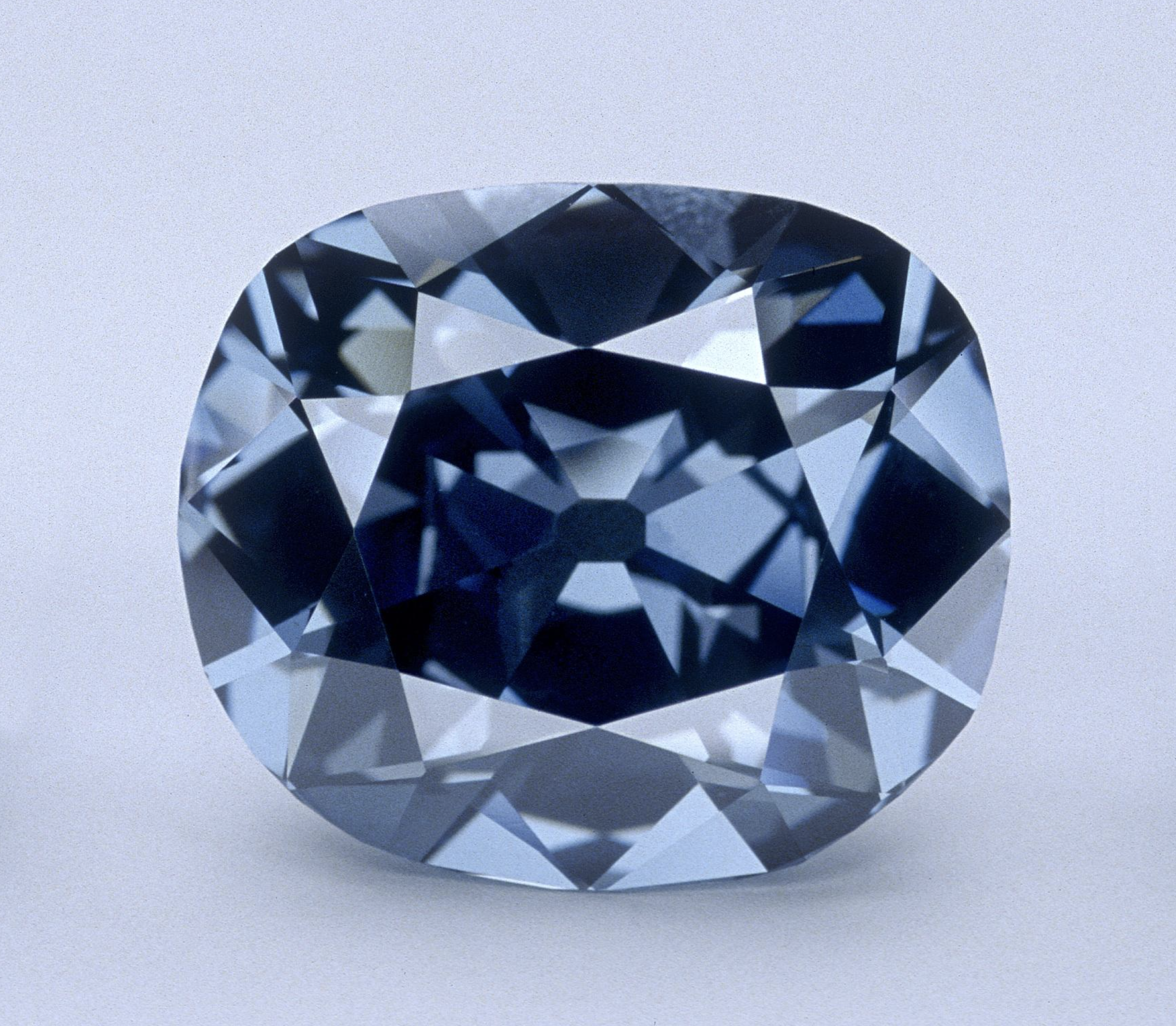
It belonged to the diamond merchant Daniel Eliason and weighed approximately 45.5 carats—considerably less than the 69-carat French Blue, but still an exceptional size. On 19 September 1812, the London jeweller John Francillon made a detailed drawing and description of it.
Francillon admired its deep blue colour, evenness and unusually fine cutting. He made no connection between Eliason’s diamond and the missing French Crown Jewel.
The timing of its appearance was suspicious. Francillon’s memorandum was dated only two days after the twenty-year limitation period for crimes committed during the French Revolution had expired. Had the diamond been concealed until that date, its possessor would have been in a much safer legal position, and France would have faced greater difficulty reclaiming it.
The stone had also been extensively recut. Its distinctive points and unusual royal design had disappeared, making it far more difficult to recognise. Whoever ordered the work sacrificed more than twenty carats but succeeded in transforming one of Europe’s most identifiable stolen treasures into a different-looking diamond.
It is not known who commissioned the recutting, who performed it or exactly when it happened.
For many years the connection between the two stones remained a strong but unproven theory. In 2007, however, researchers discovered a lead cast of the French Blue in the collection of the Muséum national d’Histoire naturelle in Paris. Computer modelling demonstrated that the 45.52-carat Hope Diamond could fit inside the original French Blue.
The discovery provided powerful scientific confirmation that they were indeed the same stone.
Did King George IV Own It?
The London diamond may briefly have entered another royal collection.
In 1823, the mineralogist John Mawe reported that the great blue stone formerly owned by Eliason was then in the possession of the British sovereign, George IV. The king was famous for his expensive tastes, enormous debts and love of luxurious jewellery, so the claim is plausible.
However, no conclusive evidence has been found in the British Royal Archives. George IV may have owned the diamond, borrowed it or simply been associated with it through rumour.
When the king died in 1830, his debts were enormous, and many of his possessions had to be sold. The blue diamond may have passed quietly into the private market at this time, but its exact route remains unknown.
The Hope Name
By 1839, the diamond was part of the celebrated gemstone collection of Henry Philip Hope, a wealthy British banker and collector.
A catalogue published that year described a magnificent deep sapphire-blue brilliant of exceptional purity and beauty. It was then mounted as a medallion, surrounded by smaller rose-cut diamonds and finished with a suspended pearl.
From this owner the stone acquired the name by which it is still known: the Hope Diamond.
Hope died in 1839 without giving clear instructions about the division of his gemstone collection. His nephews then spent approximately ten years arguing over the inheritance before reaching an agreement. The diamond eventually passed to Henry Thomas Hope.
In 1851, it was displayed at the Great Exhibition in London’s Crystal Palace, where millions of visitors came to see art, machinery, luxury goods and scientific achievements from around the world.
Debt, a Showgirl and the Birth of the Curse
The diamond remained in the Hope family until the end of the nineteenth century.
It eventually passed to Lord Francis Hope, who inherited it in 1887. Francis lived extravagantly, spent heavily on travel, entertainment and gambling, and accumulated serious debts. He later married the American actress and showgirl May Yohé, and the couple continued to live beyond their means.
Francis eventually obtained legal permission to sell the Hope Diamond in 1901.
May Yohé later claimed that she had worn it at important social occasions, including a dinner attended by the future Edward VII. Francis firmly denied this, insisting that no one had worn the diamond while it was in his possession.
Yohé subsequently used her association with the gem to promote her theatrical career. In 1921, she became involved in a book and film about its supposed curse, blaming the diamond for the loss of the Hope fortune and the failure of her marriage.
After leaving the Hope family, the diamond passed through several dealers. It travelled from London to New York and then back to Paris, while some of its owners experienced genuine financial difficulties.
By 1908, newspapers were describing it as a dangerous or cursed jewel. Tales of earlier owners were altered or invented to fit the story. Tavernier’s supposed theft from an idol and imaginary death by wild animals became part of this expanding mythology.
The curse was therefore not an ancient Indian tradition. It was largely an early twentieth-century creation, encouraged by sensational journalism, struggling owners and dealers who understood that a dramatic story could increase public interest in a famous gemstone.
Cartier and Evalyn Walsh McLean
Cartier acquired the Hope Diamond in 1910.
Pierre Cartier believed that the wealthy American heiress Evalyn Walsh McLean might be the ideal buyer. Evalyn and her husband, Edward “Ned” McLean, were already important clients and had previously bought the 94.8-carat Star of the East diamond.
Cartier presented the Hope Diamond together with an embellished account of its royal history and alleged curse. Instead of frightening Evalyn, the story fascinated her. She reportedly believed that objects bringing bad luck to other people might bring good luck to her.
Her initial objection was not the curse but the setting, which she considered old-fashioned.
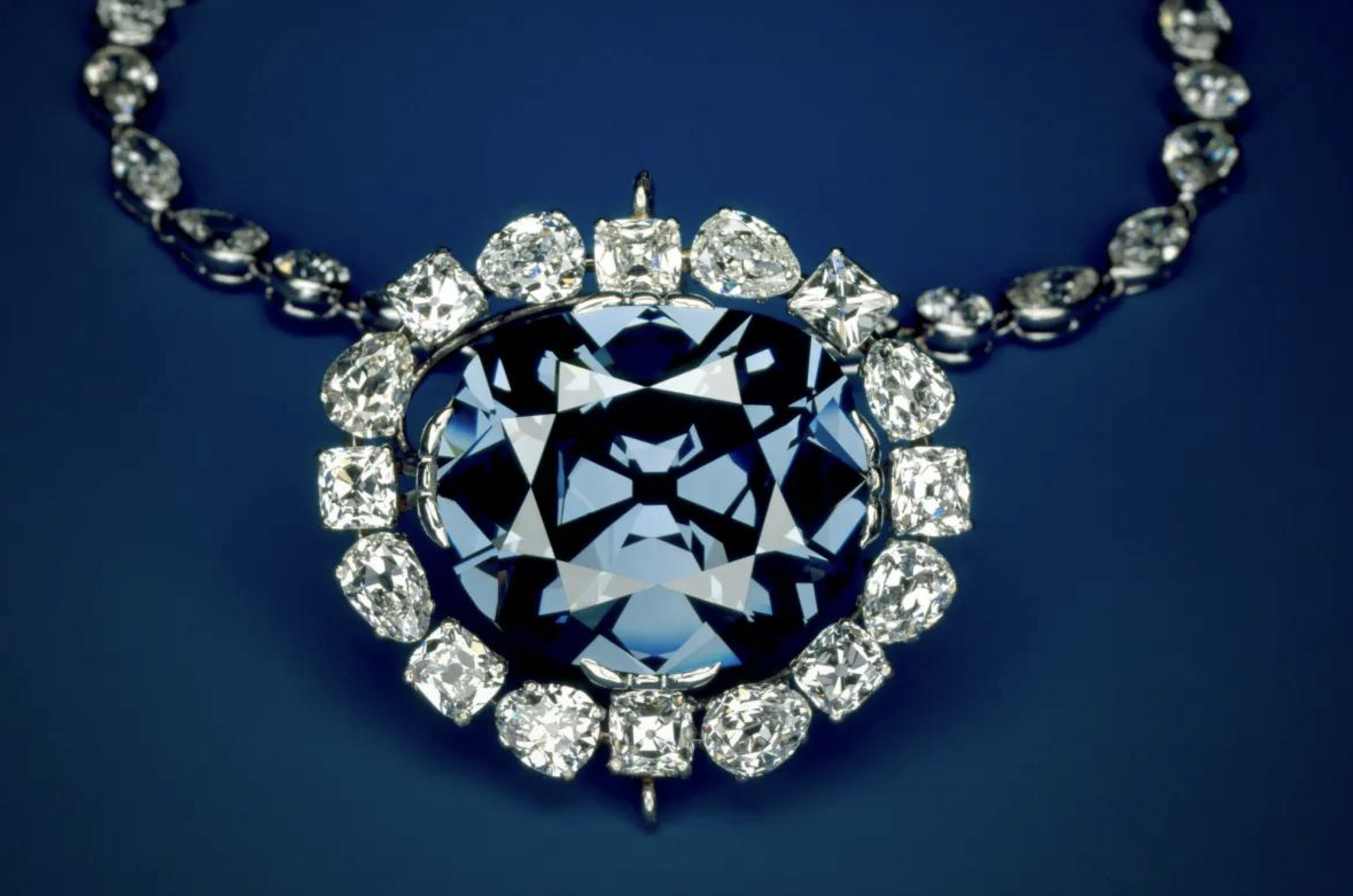
Cartier responded by having the stone remounted. He surrounded it with sixteen colourless diamonds and created a necklace that could also be adapted as a head ornament. This is essentially the setting in which the Hope Diamond is still displayed.
He then left the jewel with the McLeans for a weekend. It was a brilliant sales strategy: after living with the diamond for several days, Evalyn no longer wanted to return it.
In 1912, the McLeans purchased the Hope Diamond for approximately $180,000, together with the return of another necklace and pendant they no longer wanted.
Evalyn wore the Hope frequently and made it her signature jewel. She combined it with other important diamonds, displayed it at her lavish parties and even placed it around the neck of her Great Dane, Mike.
According to another colourful account, she brought the Hope Diamond when visiting wounded soldiers at Walter Reed Army Hospital. The soldiers were said to have passed it between them and even tossed it across the ward.
Evalyn’s life later included genuine tragedy. Her young son was killed in a road accident, her husband’s health and behaviour deteriorated until he was declared legally insane, and her daughter died from an overdose.
These events were repeatedly presented as evidence of the curse. Yet Evalyn continued to wear the diamond and never accepted that it was responsible for her misfortunes. The tragedies were real; the supernatural explanation was not.
Harry Winston and the Court of Jewels
Evalyn Walsh McLean died in 1947. Two years later, a court ordered her jewellery collection to be sold to settle debts and claims against her estate.
The collection was purchased by the New York jeweller Harry Winston.
Rather than immediately reselling the Hope Diamond, Winston made it the principal attraction of his travelling Court of Jewels exhibition. Between 1949 and 1953, the exhibition travelled around the United States, educating the public about gemstones while raising money for charities and civic organisations.
For one exhibition, the Hope Diamond was displayed dramatically within a finely woven spider’s web supported by the bare branches of a rose bush.
Winston believed that the United States should possess a major national gemstone collection. He hoped that donating an object as famous as the Hope Diamond would encourage other collectors to contribute important stones of their own.
The Most Valuable Brown Parcel in America
In November 1958, Harry Winston donated the Hope Diamond to the Smithsonian Institution.
The method of delivery was surprisingly ordinary.
On 8 November, the diamond was placed inside a box, wrapped in plain brown paper and taken to the post office in New York. Winston sent it to Washington by registered first-class mail because he considered the postal system the safest way to transport valuable gemstones.
The parcel weighed a little over five pounds. The ordinary postage cost only $2.44. Registration and insurance brought the total mailing cost to $145.29, with the contents insured for approximately one million dollars.
Two days later, postal carrier James G. Todd delivered the package to the Smithsonian, where it was formally accepted in front of journalists and photographers.
The curse story soon produced one final anecdote. Within a year, Todd was involved in two road accidents, his wife died, his dog was killed and part of his house was damaged by fire.
When a reporter asked whether he blamed the Hope Diamond, Todd refused to accept the suggestion. He pointed out that his children had escaped the fire unharmed and joked that, since the public now owned the diamond, any curse would presumably have to affect everyone.
A Royal Jewel Becomes a Scientific Treasure
The Hope Diamond has remained at the Smithsonian’s National Museum of Natural History ever since.
It weighs 45.52 carats and is classified as a rare type IIb diamond. Traces of boron within its crystal structure produce its famous blue colour. When exposed to ultraviolet light, the stone continues to glow with a striking reddish phosphorescence for several seconds after the light source has been removed.
Today, it hangs within the Cartier-designed pendant, surrounded by sixteen colourless diamonds and suspended from a chain containing another forty-five diamonds.
Since its donation in 1958, more than one hundred million visitors have seen it. It is one of the Smithsonian’s most popular objects and continues to be studied by mineralogists, historians and gemmologists.
The Hope Diamond lost more than half its original weight as it was repeatedly recut. It changed shape, name, setting, country and owner. It survived royal courts, revolution, theft, financial ruin and some of the most successful jewellery marketing ever devised.
Its supposed curse may be a modern invention, but the real history is arguably even more remarkable: a blue diamond traded in seventeenth-century India became a symbol of the Sun King, disappeared through an unguarded window during the French Revolution and, almost three centuries later, arrived at an American museum with just $2.44 in postage.
