From the Mines of India to Napoleon’s Sword and the Louvre
Few diamonds have served as so many different symbols of power as the Regent Diamond.
It began as an enormous rough stone in India, crossed the world through the hands of merchants and colonial officials, became the most important diamond in the French Crown Jewels, disappeared during the French Revolution and was later used as financial security by a government in desperate need of money.
Napoleon placed it in the hilt of his ceremonial sword. Later French rulers returned it to crowns and royal ornaments. When most of the French Crown Jewels were broken up and sold, the Regent was spared.
Today, the diamond belongs to the Louvre. Yet the beginning of its story lies somewhere between surviving records and one of the darkest legends in jewellery history.
An Extraordinary Diamond from India
The diamond was discovered in 1698 in the famous diamond-producing region traditionally described as the mines of Golconda in India.
The rough stone weighed approximately 426 carats. Even before cutting, its exceptional transparency and size made it an object of enormous commercial interest.
At the end of the seventeenth century, India was still the world’s principal source of diamonds. Large stones were exceptionally rare, and the finest examples could attract the attention of rulers, merchants and European trading companies. A rough diamond of more than 400 carats was therefore not merely a valuable gemstone. It was potentially a political object, capable of enriching a merchant or entering the treasury of a king.
The exact circumstances of its discovery are not securely documented. That gap in the historical record allowed a much more dramatic story to develop.
The Enslaved Miner and the Wound in His Leg
The most famous version of the story claims that the diamond was discovered by an enslaved labourer working in an Indian mine.
Large diamonds were supposedly reserved for the local ruler, and workers were carefully searched when leaving the mining area. Realising that such a stone could change his life, the man is said to have cut open his own leg and hidden the diamond inside the wound or beneath its bandages.
Pretending to have been injured while working, he was taken away from the mine. According to the legend, he then escaped and travelled towards the coast, hoping to sell the diamond and obtain his freedom.
There he met an English sailor or ship’s captain. The miner allegedly offered to share the proceeds if the sailor would help him reach a safer destination. Instead, the sailor murdered him, threw his body into the sea and kept the stone.
The sailor then sold the diamond to Indian merchants. In some later versions of the story, he rapidly spent the money, became consumed by guilt and eventually took his own life. The stone was then resold to Thomas Pitt, the British governor of Fort St George in Madras.
It is a powerful story, but it should be treated as legend rather than established history. The names of the miner and sailor are unknown, no contemporary eyewitness account survives, and the violent prehistory of the diamond appears mainly in later retellings.
The first firmly documented chapter begins when the stone was offered to Thomas Pitt at the beginning of the eighteenth century.
Thomas “Diamond” Pitt
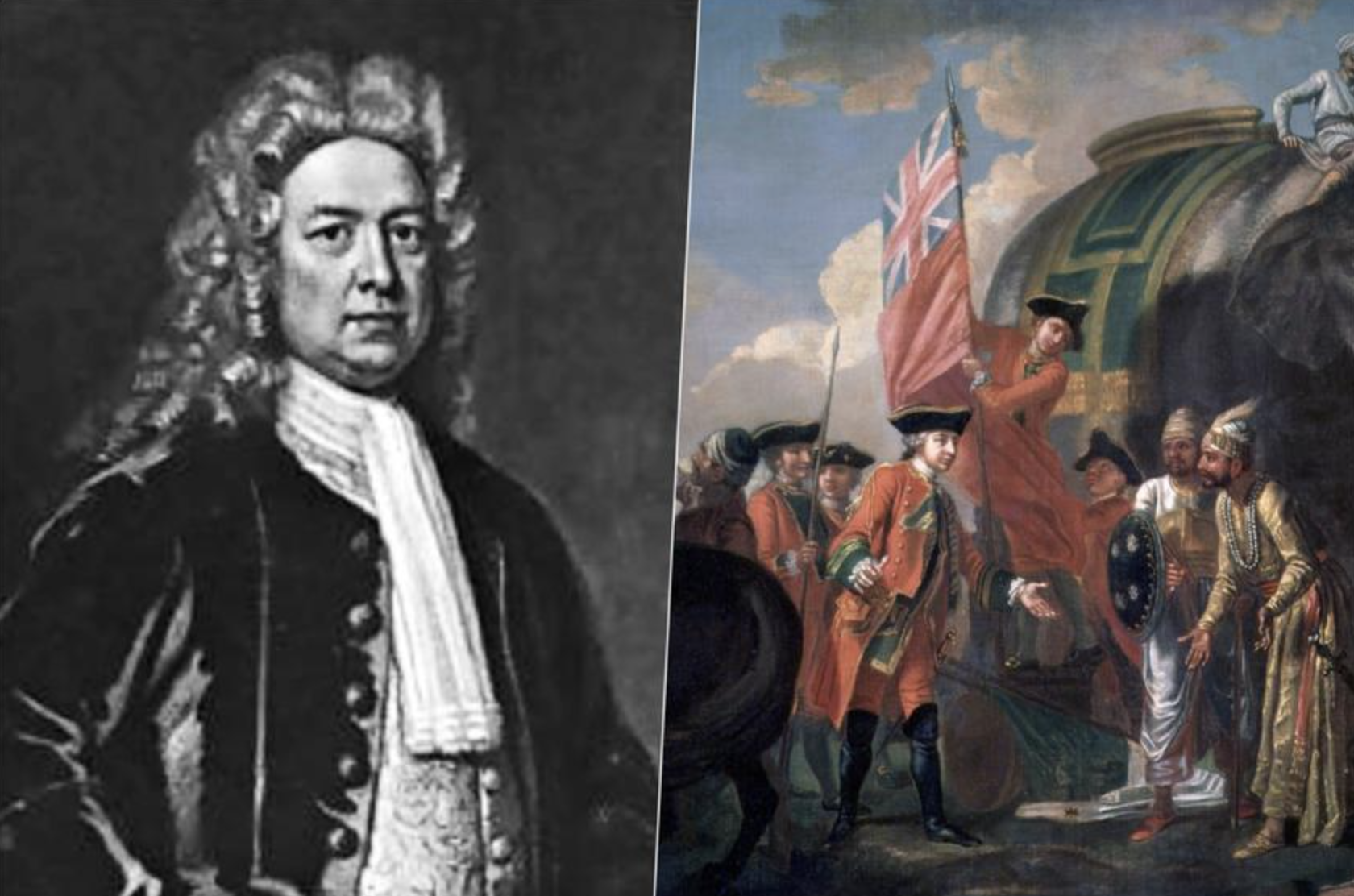
Thomas Pitt was governor of Fort St George, the East India Company settlement at Madras. He was already a wealthy merchant with extensive experience in Asian trade when an Indian dealer offered him the enormous rough diamond.
Pitt eventually purchased it for approximately £20,400, an immense sum at the time. The transaction later attracted suspicion, and critics accused him of acquiring the stone dishonestly or exploiting those who had possessed it before him.
Pitt strongly defended the legitimacy of the purchase. Whatever the truth of the diamond’s earlier journey, the surviving record establishes that he bought it through a commercial transaction and sent it to England in 1702.
The diamond soon became so closely associated with him that it was known as the Pitt Diamond. It also earned Thomas Pitt the enduring nickname “Diamond Pitt”.
The possession of such a stone brought him prestige, but also considerable anxiety. It was too valuable to sell easily, too famous to move without attracting attention and potentially dangerous to own in an age when transporting valuable gemstones involved very little security.
Two Years on the Cutting Wheel
Once in England, the rough diamond was entrusted to cutters.
The work took approximately two years, between 1704 and 1706. Cutting a diamond of this size was an extraordinary technical undertaking. Every decision carried enormous financial consequences: one mistake could damage or destroy a stone worth a fortune.
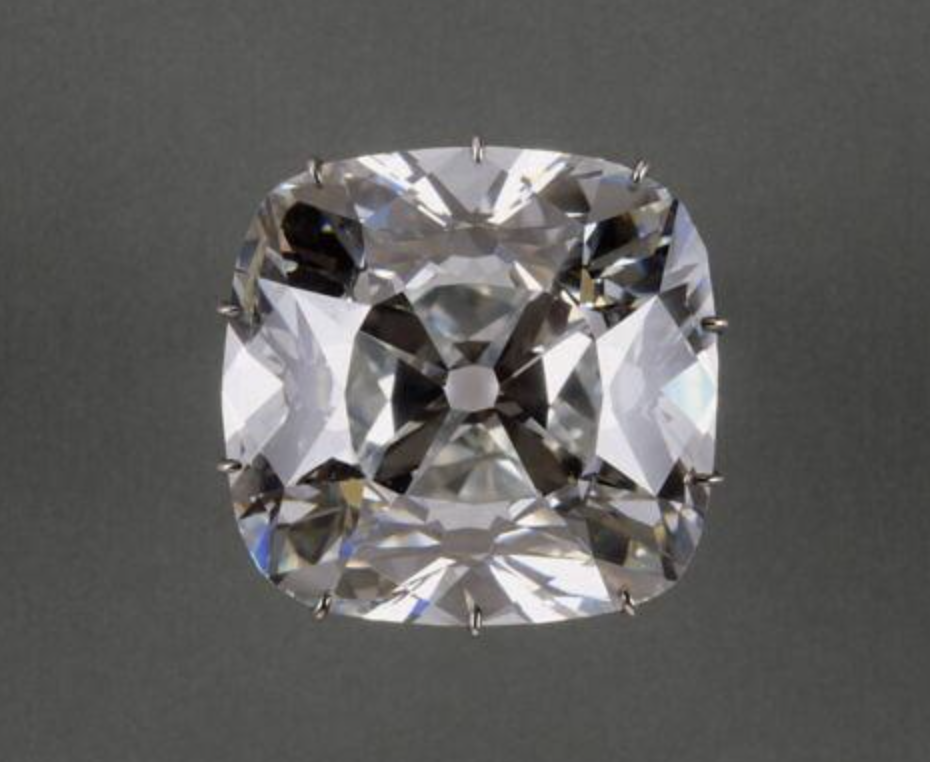
The cutter transformed the irregular 426-carat rough into a remarkably symmetrical cushion-shaped old brilliant of 140.64 metric carats. The finished diamond measures approximately 3.2 by 3.1 centimetres.
Only about one-third of the original weight remained in the principal stone. Several smaller diamonds were also obtained during the cutting process, and some were reportedly sold separately.
The loss of so much weight may appear astonishing, but the goal was not to preserve as many carats as possible. The cutter wanted to remove imperfections and create a stone of exceptional symmetry, brilliance and transparency.
The result was regarded as one of the finest examples of early brilliant cutting. The Regent is nearly colourless, with only a very faint blue-green tint, and its purity is considered exceptional.
It became celebrated not merely for being large, but for the quality of its cut.
A Diamond Too Expensive Even for Kings
Pitt now faced a new problem: finding someone wealthy enough to buy it.
The pool of potential purchasers was extremely small. Only the richest monarchs, royal treasuries and financiers in Europe could even consider such a transaction.
Pitt spent years trying to arrange a sale. The stone was offered to a succession of wealthy clients, but its price was considered too high.
The diamond was magnificent, but it was also financially awkward. An individual buyer might possess the money to acquire it, yet spending such a sum on one gemstone could appear extravagant or politically irresponsible.
The situation changed after the death of Louis XIV in 1715. The new French king, Louis XV, was still a child, and France was governed by his cousin, Philippe II, Duke of Orléans, as regent.
Philippe understood that the diamond could serve not only as a jewel, but as a national symbol.
The Regent Buys the Pitt Diamond
On 6 June 1717, Philippe d’Orléans persuaded the French Regency Council to approve the purchase.
France paid approximately two million livres for the diamond. The enormous expenditure was justified as an enhancement of the dignity and prestige of the French Crown.
The transaction earned Pitt an extraordinary profit. More importantly, it transformed the stone from the private property of an English merchant into part of the French national treasury.
From that moment, the Pitt Diamond became known as Le Régent — the Regent — in honour of Philippe d’Orléans.
The new name also reflected a fundamental change in the diamond’s identity. It was no longer merely a valuable stone looking for a buyer. It had become one of the central symbols of the French monarchy.
Within only a few years, its estimated value had increased dramatically.
Louis XV and the Crown of France
The young Louis XV first wore the Regent in 1721, during the formal reception of an Ottoman embassy.
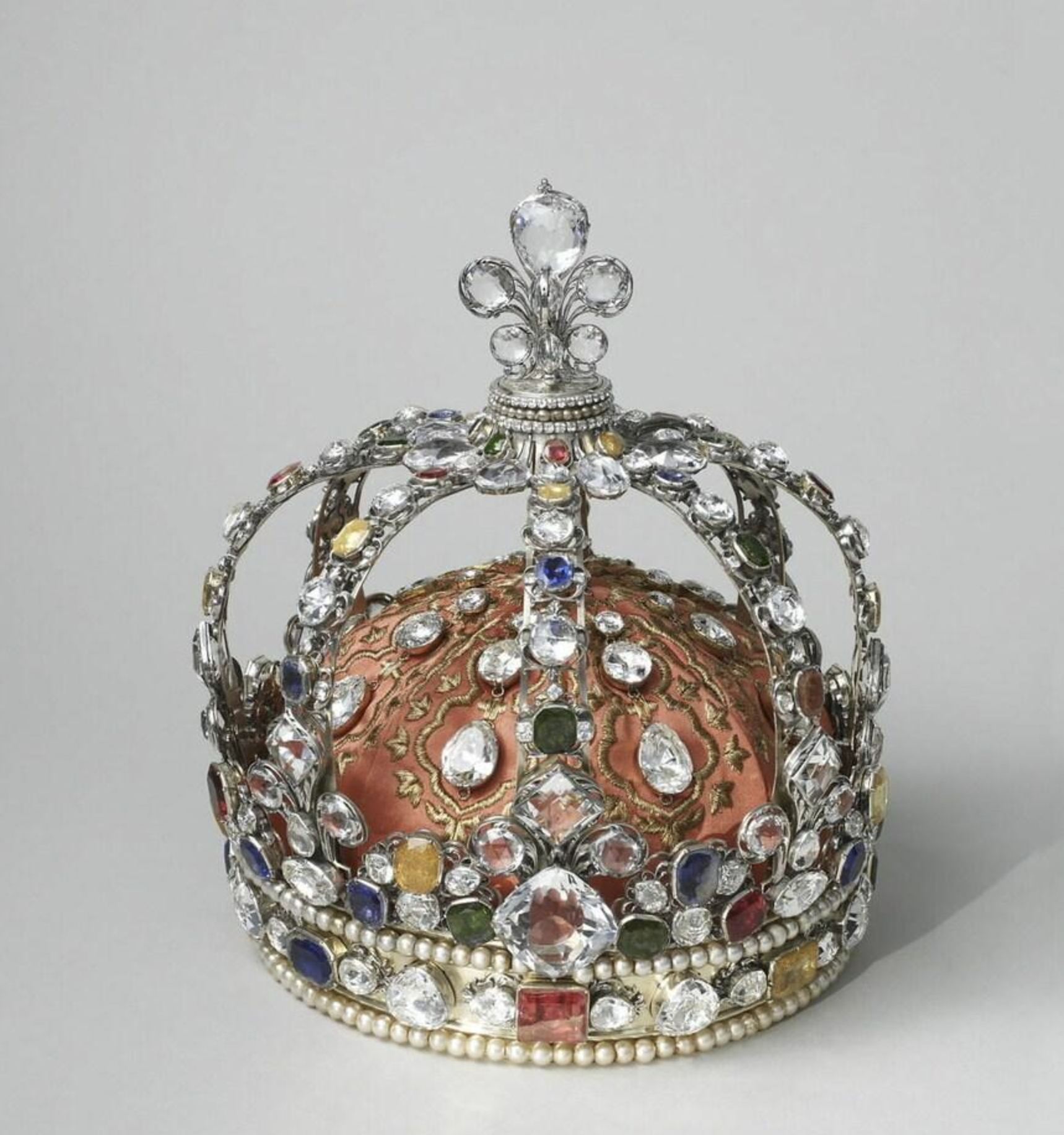
The following year, the diamond was temporarily mounted at the front of the crown created for his coronation at Reims on 25 October 1722. Its position ensured that the largest and most brilliant stone faced directly towards those watching the ceremony.
The crown was not simply an expensive ornament. During a coronation, every object carried political and religious meaning. By placing the Regent at the front, the monarchy presented the diamond as a visible expression of dynastic authority and French wealth.
After his marriage to Marie Leszczyńska in 1725, Louis XV also began wearing the Regent on his hat. The diamond was therefore removable and could pass between ceremonial settings depending on the occasion.
This adaptability was typical of important royal stones. The diamond itself was permanent, while its surrounding mountings could change with fashion, protocol and political purpose.
Louis XVI and the Last Years of the Monarchy
For the coronation of Louis XVI in 1775, a new crown was made in a style similar to that of Louis XV. Once again, the Regent was placed in a commanding position at the front.
Louis XVI also followed his grandfather’s example by wearing the diamond on his hat.
It is sometimes claimed that Marie Antoinette wore the Regent, but the diamond was primarily associated with the male insignia and ceremonial regalia of the French monarch. Its best-documented eighteenth-century uses were in the crowns and hats of Louis XV and Louis XVI.
By the late 1780s, however, royal diamonds had acquired a dangerous political meaning. To supporters of the monarchy they embodied France’s greatness. To its critics they represented privilege, extravagance and the concentration of wealth in the hands of the Crown.
When the Revolution began, the Regent’s identity changed again. It was no longer merely the king’s diamond. It was declared part of the property of the nation.
The Great Theft of the French Crown Jewels
After the royal family’s failed attempt to escape France in 1791, the Crown Jewels were transferred to the Garde-Meuble national, a government storehouse on what is now the Place de la Concorde.
The jewels were placed in cabinets and, remarkably, were sometimes shown to members of the public.
Security was inadequate.
On the night of 11 September 1792, thieves climbed through a first-floor window and entered the room containing the Crown Jewels. Because the official seal on the door remained intact, the theft was not immediately discovered.
The criminals returned over several nights. As more people became involved, they grew increasingly careless. By 17 September, the group reportedly numbered dozens of participants.
The Regent disappeared alongside the French Blue, the Sancy and numerous other royal gemstones.
For the first time since entering the French treasury, Europe’s most famous white diamond had vanished.
The Diamond Hidden in a Roof Beam
The Regent was almost impossible to sell in its existing form.
Unlike smaller diamonds that could be removed from their settings and quietly dispersed, the Regent was instantly recognisable. Its extraordinary dimensions and distinctive cutting made it dangerous merchandise for any thief or dealer.
Approximately one year later, the authorities traced members of the group to a house in a Paris suburb. The Regent was found concealed in the structure of the building, hidden inside a roof timber or beam.
Unlike the French Blue—which was never recovered in its original form—the Regent returned to the national treasury.
Its recovery did not mean that it immediately returned to ceremonial use. Revolutionary France had little interest in royal display, but it desperately needed money.
The diamond was therefore transformed into something much more practical: financial collateral.
The Republic Pawns the Crown Diamond
During the years following the Revolution, the French government repeatedly pledged the Regent as security for loans.
In 1797, it was deposited with a Berlin banker as part of the financial arrangements connected with France’s military campaigns in Italy.
The stone that had once symbolised the divine authority of kings had become, in effect, a portable reserve fund for the Republic.
This is one of the most interesting changes in the diamond’s history. Its physical appearance remained the same, but its meaning altered completely.
Under Louis XV, it had represented royal magnificence. During the Revolution, it became national property. Under the Directory, it functioned as security for government debt.
Then Napoleon Bonaparte decided that it should represent personal power once again.
Napoleon Redeems the Regent
After becoming First Consul, Napoleon ordered the government to recover the Regent from its creditors.
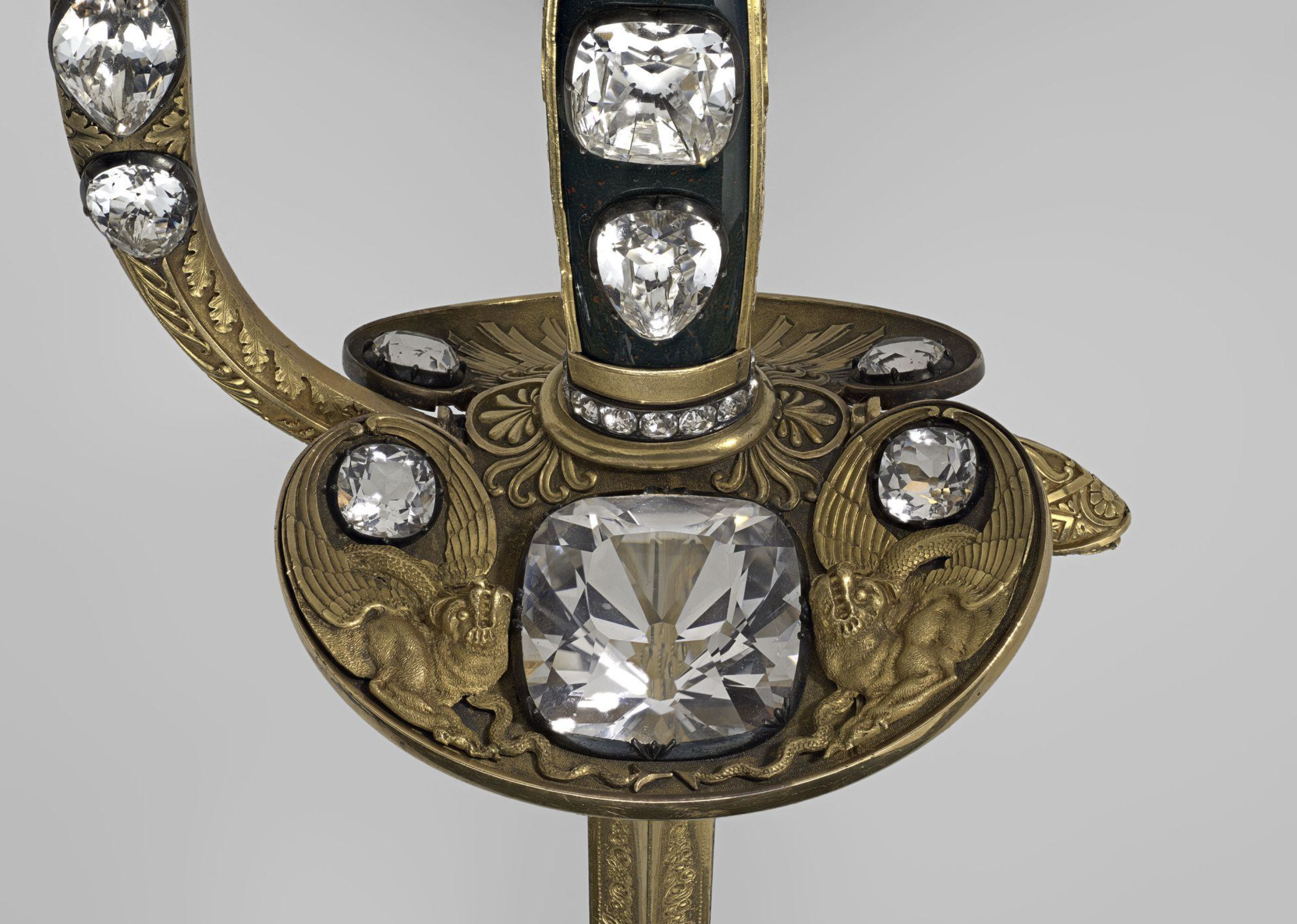
The stone was formally redeemed in February 1801. Napoleon then commissioned a ceremonial sword whose hilt would be designed around the diamond.
The commission was explicit: the sword was to be appropriate to Napoleon’s position as head of state and was to be decorated with the Regent and other diamonds of exceptional value.
The sword brought together the work of several important French craftsmen. The blade came from the Versailles arms manufactory of Nicolas-Noël Boutet. Marie-Étienne Nitot, founder of the house later known as Chaumet, set the gemstones. The gold fittings were made by the goldsmith Jean-Baptiste-Claude Odiot.
The completed weapon contained 42 brilliant-cut diamonds, together weighing more than 250 carats. At the centre of the guard sat the Regent.
The symbolism was unmistakable. Napoleon was not born into the French royal family, but by placing the greatest diamond of the former monarchy on his sword, he presented himself as the inheritor of France’s power and history.
Napoleon’s Lucky Diamond
Napoleon may also have regarded the Regent as a personal talisman.
The diamond had helped finance the Italian campaign that first established his military reputation. Once he gained power, he ensured that it was recovered and placed on the weapon that identified him as head of state.
He wore the sword at major ceremonies, including the proclamation of the Concordat and his coronation in Notre-Dame Cathedral on 2 December 1804.
The contrast with the French kings was striking.
Louis XV and Louis XVI had worn the Regent above their faces, in crowns and hats. Napoleon placed it on a sword—a symbol not only of authority, but of conquest and military achievement.
In 1812, the diamond was transferred to another imperial sword created by Nitot.
New Rulers, New Settings
After Napoleon’s fall, France passed through a succession of monarchies and empires. Each regime attempted to claim continuity with the past, and the Regent remained too important to ignore.
The diamond was mounted in the ceremonial crowns of Louis XVIII, Charles X and later Napoleon III.
Under the Second Empire, it was incorporated into the Greek-style diadem of Empress Eugénie, the wife of Napoleon III. Once again, the stone was transformed to suit a new ruler and a new visual language of power.
Through these repeated remountings, the Regent became something more than the property of a particular dynasty. Bourbons, revolutionaries, Bonapartes and restored monarchs all considered it capable of legitimising their authority.
The governments changed. The diamond remained.
The Sale of the French Crown Jewels
After the fall of Napoleon III and the creation of the French Third Republic, the Crown Jewels presented a political problem.
To many republicans, the collection represented the possibility of another restoration of the monarchy. In 1887, the French state decided to sell almost all of it.
Historic settings were dismantled and jewels that had survived centuries of revolution and regime change were dispersed at auction.
The Regent, however, was deliberately excluded from the sale.
Its importance was considered greater than its association with any one ruler. It had become a national historical object rather than merely a royal possession.
The decision saved the diamond from the fate of many other French Crown Jewels, whose gemstones were separated, recut or placed in new settings after the auction.
The Regent at the Louvre
The Regent remains one of the most important surviving objects from the French Crown Jewels.
It weighs 140.64 metric carats and retains the cushion-shaped old brilliant cut created in England at the beginning of the eighteenth century. The diamond is celebrated for its exceptional transparency, its almost colourless appearance and the balance of its early faceting.
It entered the Louvre not merely as a remarkable mineral, but as an object carrying almost two centuries of French political history.
It had crowned kings, disappeared through a window during a revolution, been hidden inside a roof, pledged to bankers, redeemed by Napoleon and mounted in imperial and royal regalia.
Legend, Violence and Survival
The most dramatic account of the Regent’s beginning may never be proven.
Perhaps an enslaved miner really did hide the rough stone beneath the bandages of a self-inflicted wound. Perhaps a sailor murdered him for it. Or perhaps those details were later inventions created to give an already famous diamond a suitably violent origin.
What is certain is remarkable enough.
A 426-carat Indian rough diamond entered the hands of an English colonial governor. It was reduced to a 140.64-carat brilliant whose quality made it famous throughout Europe. It was purchased by the ruler governing France, worn by kings, stolen by revolutionaries and used by a republic as collateral.
Napoleon then placed it on his sword, turning a relic of the Bourbon monarchy into a symbol of imperial power.
Unlike the Hope Diamond, the Regent did not need a curse to become legendary. Its real history—commerce, colonialism, royal ambition, revolution, theft and survival—is more compelling than any supernatural tale.
And perhaps that is why it endured when so many other Crown Jewels were dispersed. By 1887, the Regent no longer belonged solely to a king, an emperor or even a dynasty.
It had become part of the history of France itself.
